



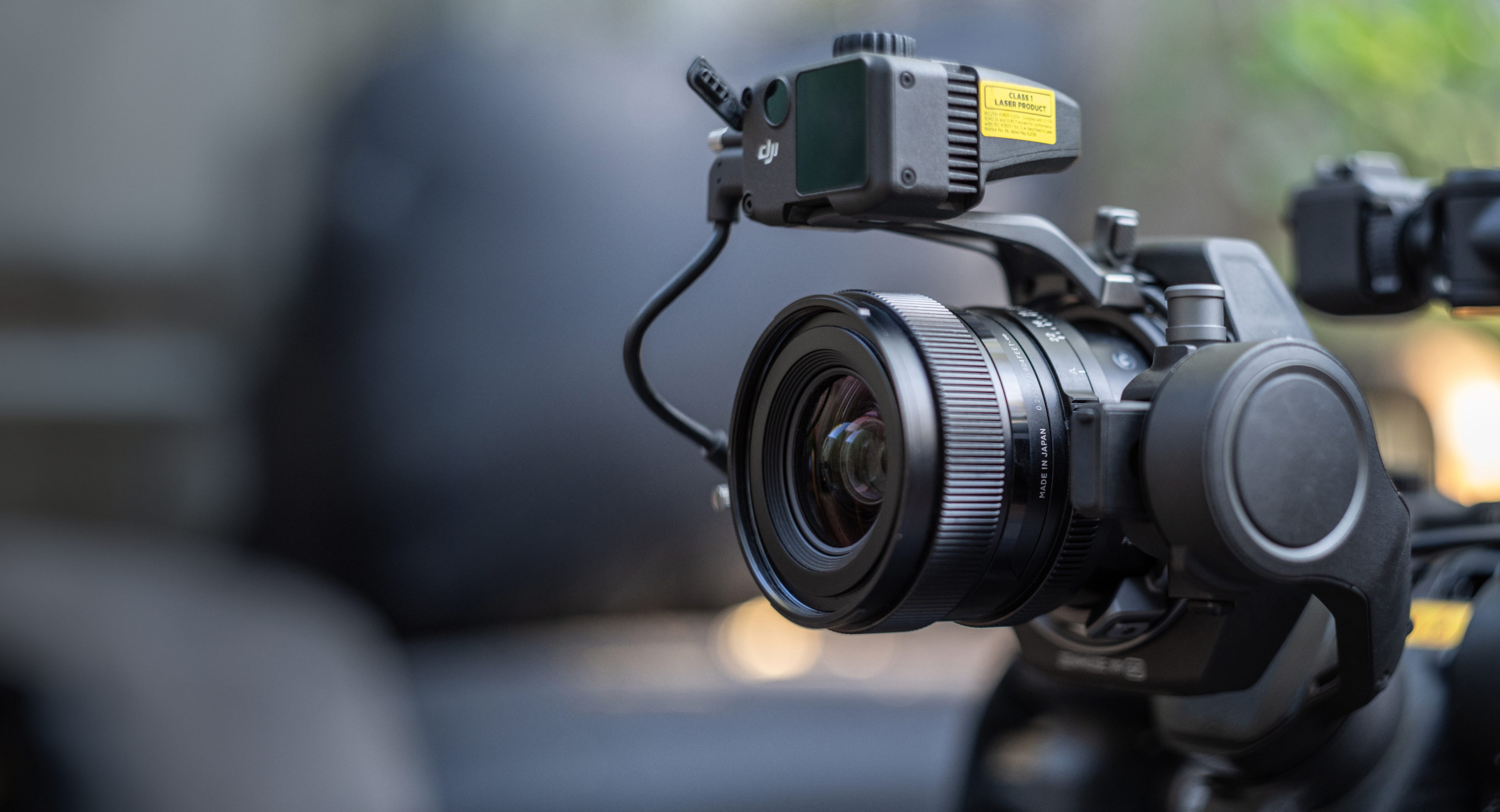
Sigma lens technology enables the photographer to
express his own sensitivity through images.
Sigma has refined optical technology, in order to fully
realize the possibilities of single lens reflex cameras
and to respond exactly to the demands of the photographer,
helping him to bring his vision to reality.
Sigma’s huge choice of lenses enables photo enthusiasts
to maximize their creativity. Each and every Sigma lens
offers optimum optical performance and smooth handling
characteristics through a combination of experience
and advanced technology. Sigma’s design and precision
engineering helps photographers to maximize their true
creativity by fulfilling the full potential of their
cameras.
Aspherical
lenses.
The aspherical lens complex allows freedom of design,
improved performance, a reduced number of component
lenses and a compact size.
This lens provides high optical performance
while maintaining a compact size. For example, the 12-24
mm F4.5-5.6 EX DG ASPHERICAL lens widens the range of
wide-angle lenses, and it provides distortion-free images
with image reproduction performance equivalent to that
of a single focal length lens. Aspherical lenses allow
the production of high-quality images from compact,
lightweight telephoto zoom lenses.

APO
Lens
In order to attain the highest quality images, the
APO lens has been made using special low-dispersion
(SLD) glass and is designed to minimize color aberration.
SIGMA's APO zoom lenses minimize color aberration.
As the refractive index of glass depends on the wavelength
of light, color aberration occurs when different colors
form images at different points. This problem often
occurs with telephoto lenses, but the Special Low-Dispersion
(SLD) glass and
Extraordinary Low Dispersion (ELD) used in SIGMA's APO
lenses helps to compensate for color aberration, thereby
allowing them to produce of sharp images.
OS
(Optical Stabilizer) Function
This function utilizes a built-in mechanism that
compensates for camera shake. It dramatically expands
photographic possibilities by alleviating camera movement
when shooting by hand held camera.
Developed with Sigma's own technology, the OS (Optical
Stabilizer) function uses two sensors inside the lens
to detect both vertical and horizontal movement of the
camera. This function, which works by moving an optical
image stabilizing lens group, to effectively compensate
for camera shake, helps to set our lenses apart from
the rest. To handle all types of shooting conditions,
the system has two optical stabilizer modes. Mode 1
determines camera shake in vertical and horizontal panning
and compensates for image blurring. It is therefore
effective for taking general photography or for shooting
landscapes and other static subjects. Mode 2 detects
vertical camera shake and compensates for blurring.
It is effective for panning the camera to photograph
moving subjects such as motor sports.
APO
Teleconverter EX
This lens can be used with the APO Teleconverter
EX. It can increase the focal length and will interface
with the camera's AE (automatic exposure) function.
EX
Lens
The exterior of this lens is EX-finished to denote
the superior build and optical quality, and to enhance
its appearance.
Hyper-Sonic
Motor
This lens uses a motor driven by ultrasonic waves
to provide a quiet, highspeed AF.
Inner
Focus
To ensure stability in focusing, this lens moves
the inner lens group or groups without changing the
lens' physical length.
Rear
Focus
This lens is equipped with a system that moves the
rear lens group for highspeed , silent focusing.
Conventional focusing has normally been performed by
moving either all lens groups as a fixed unit or only
the first lens group. AF cameras are now widely used,
even for close-up photography. Consequently, demand
has arisen for a focusing system that will keep the
length of the lens unchanged while showing little fluctuation
of aberration. In response to this demand, SIGMA has
developed a new inner focus system that moves two lens
groups inside the telephoto and telephoto MACRO lenses.
This system has floating elements that substantially
improve the close-up capability of the lens. The super
wide angle lens having a large front-lens uses a rear
focusing system to move the rear-lens apparatus and
enhance the floating effect, and the18-125 mm F3.5-
5.6 DC lens uses an inner focusing system to move the
secondary lens apparatus. SIGMA has also succeeded in
attaining a minimum shooting distance of 19.7 inches/0.5
m throughout the entire zoom range of this lens. The
rear focus system ensures high-speed focusing with the
APO 135-400 mm F4.5-5.6 DG and APO 170-500 mm F5-6.3
DG telephoto zoom lenses.
DG
Lens
The most suitable lenses for 35mm film single-lens
reflex cameras, as well as for digital SLR cameras.
Sigma's development of the DG (Digital) range of lenses
has concentrated on the correction of distortion and
aberrations. Magnification of chromatic aberration is
particularly conspicuous with digital cameras. The optical
designs and cutting-edge technology incorporated by
Sigma eliminate flare and ghosting from te image sensor
and create excellent color balance. Vignetting is minimized
whilst marginal illumination is ensured. These high
performance lenses are equally suited for digital and
analogue cameras.
DC
Lens
These are special lenses designed so that the image
circle matches the smaller size of the image sensor
of most digital SLR cameras. Their specialized design
gives these lenses the ideal properties for digital
cameras, the compact and lightweight construction is
an added bonus!
Floating System
The floating system is used to control the focus. This
system moves the different lens groups in the optical
system to different positions, thereby minimizing the
telescoping distance and the fluctuation of aberration
at different shooting distances. This system is particularly
effective for macro lenses (which encompass a wide range
of shooting distances) and wide angle lenses (for Single-Lens
Reflex cameras) whose lens composition is asymmetric.
SIGMA uses the floating system for the MACRO 50 mm F2.8EX
DG lens and the large-aperture wide-angle 28 mm F1.8 EX
DG ASPHERICAL MACRO lenses.
DF (Dual Focus) System
The DF (Dual Focus) system disengages the linkage between
the internal focusing mechanism and outer focusing ring
when the focusing ring is moved to the AF position.
This system provides easy and precise handling of the
lens, since the focusing ring does not rotate during
autofocusing. The wide focusing ring also enables easy
and accurate manual focusing.
Zoom Macro
Although telephoto zoom lenses can be used closer to the
object than single-focal length telephoto lenses, there
is still a minimum shooting distance. SIGMA has made this
minimum distance smaller and developed the zoom MACRO
lens for taking close-up photographs of the same quality
as those taken with a regular MACRO lens, while maintaining
the performance specific to an APO lens. Rather than carrying
around the cumbersome accessories required for close-up
work, the photographer can now take photographs at a magnification
of 1:2 (one half life size) using a telephoto lens, by
quickly shifting from the normal setting to the full macro
setting.